

Enterprise Link Building: Strategy, Execution, and Scaling

Erika
Head of Link Operations
Most enterprise link building programs don’t fail on outreach. They fail on governance.
The outreach works fine. Someone lands a placement on a solid publication, and then it sits in a legal review queue for three weeks. Two business units hire two different agencies that both target the same 40 publishers. A regional team buys sponsored placements with exact-match anchors because nobody told them there was a policy. And the SEO lead ends up in a quarterly review explaining why $400,000 of link spend produced a backlink profile that looks like four companies built it.
That’s the enterprise problem. It’s not “how do we get links.” It’s “how do we get the right links to the right pages across 12 properties, 6 markets, and 30 stakeholders without creating a footprint that reads as manipulation.”
This guide covers all three parts of that problem. Strategy: deciding where links go before deciding how to get them. Execution: running the program across teams, regions, and vendors. Scaling: adding volume without adding risk. If you’re looking for outreach mechanics or how to hit a monthly placement number, we cover that in our guide to scaling link building without sacrificing quality. This post is about the layer above it.
What Enterprise Link Building Involves
Enterprise link building is the coordinated acquisition of editorial backlinks across a large organization’s web properties, managed under a single link policy, prioritized by commercial value, and executed through a mix of internal teams and external partners.
That definition matters because it’s what separates enterprise work from “link building for a big company.” A big company can run a normal campaign if it has one site, one SEO owner, and one budget. Enterprise link building starts when at least two of these are true:
You have multiple properties. Subdomains, country sites, acquired brands, microsites, and product documentation portals all compete for the same attention and, often, the same publishers.
You have multiple decision-makers. SEO, brand, legal, PR, regional marketing, and procurement all have veto power over some part of the process.
Your link profile is under scrutiny. Competitors study it. Journalists occasionally study it. And Google’s systems treat a brand with 50,000 referring domains differently from one with 500, because the patterns are visible at that scale.
You’re buying through procurement. Vendor onboarding, security reviews, and master service agreements shape which partners you can even work with.
When those conditions apply, the tactics don’t change much. The management layer changes completely.
Strategy: Decide Where Links Go Before Deciding How to Get Them
Enterprise programs that start with “let’s get more links” end up with links pointed at whichever pages the loudest stakeholder cared about that quarter. Strategy work is about replacing that with a defensible allocation model.
Map the full estate
Start with an inventory of every property that resolves under your brand, including the ones nobody in marketing knows about. Legacy microsites from campaigns that ended years ago. Regional subdomains that were set up for one product launch. Documentation portals owned by engineering. Acquired brands that still run on their own domains.
For each one, record who owns it, what it’s for, whether it should exist at all, and what its current backlink profile looks like. Most enterprises find the same thing on this pass: link equity is pooled in one or two properties while revenue-critical pages on others have almost nothing. That imbalance is a strategy problem before it’s an outreach problem.
For multi-regional businesses, this map also needs to reflect how Google reads your regional structure. Google’s documentation on managing multi-regional and multilingual sites lists links from local sites as one of the signals it uses to determine a page’s target audience, alongside ccTLDs, hreflang, and server location. So a German product page on example.com/de/ doesn’t just need links. It needs links from German publishers to reinforce the geographic targeting your hreflang markup is already claiming.
Prioritize by revenue, not by request
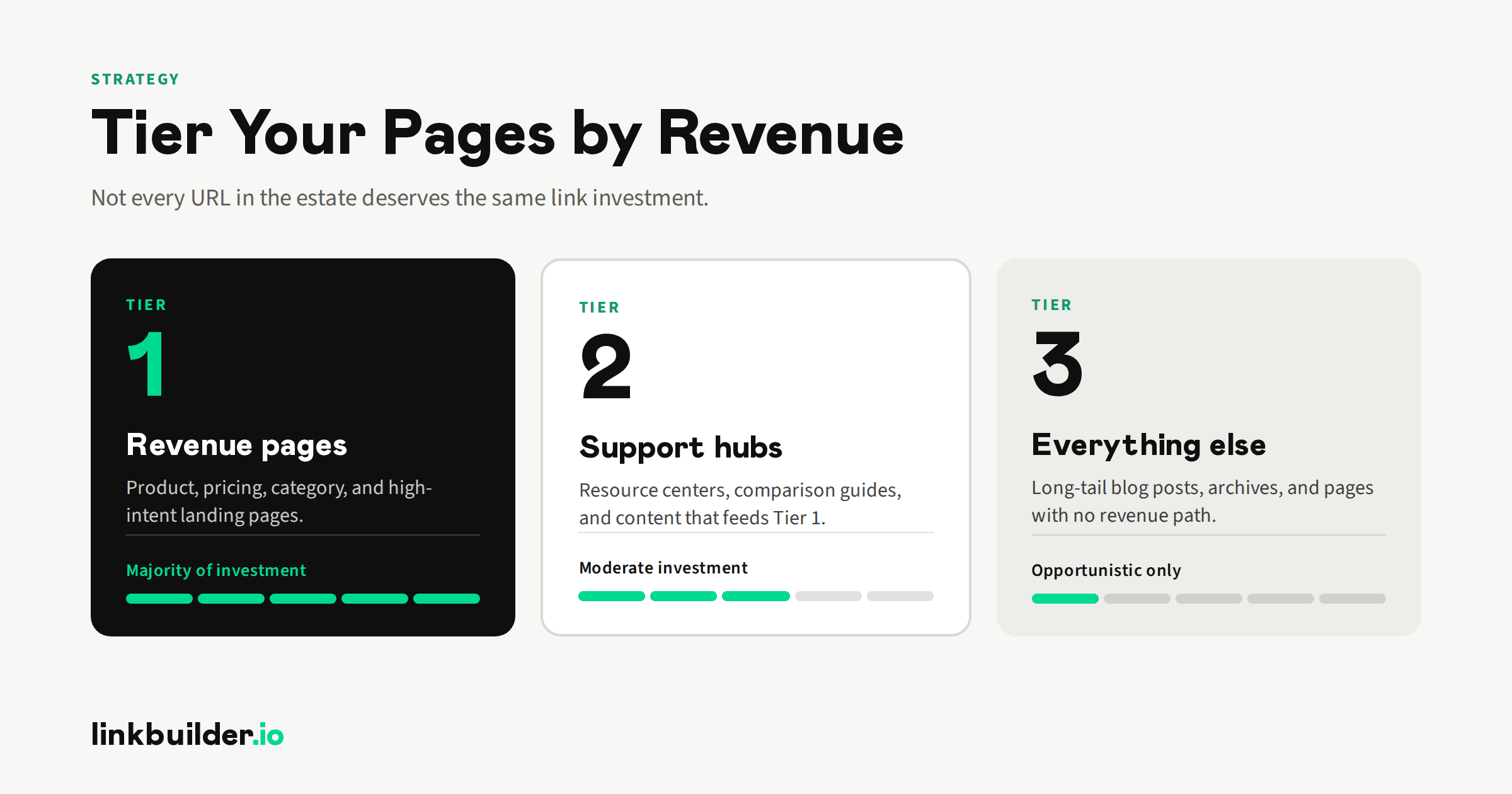
Once you know what you have, tier it. A simple three-tier model works for most organizations:
Tier 1 pages drive measurable revenue or pipeline and sit in competitive results. Product category pages, core service pages, high-intent comparison content. These get the majority of link investment and the highest-quality placements.
Tier 2 pages support Tier 1 through internal linking and topical authority. Pillar guides, research hubs, resource centers. These earn links more naturally and need less direct spend.
Tier 3 pages are everything else. Blog posts, news, regional variants of Tier 2 content. These get links opportunistically, usually as a byproduct of digital PR campaigns, and rarely get dedicated outreach.
Business units will push back on this. The regional marketing lead wants their landing page treated as Tier 1. The product team wants their new feature page prioritized. The tiering model gives the SEO owner a neutral answer: show me the revenue attribution and the keyword difficulty, and we’ll re-tier.
Write one link policy for the whole company
This is the document that prevents the four-companies-built-it problem. It should be short enough that a regional agency reads it and specific enough that legal can sign off on it once. At minimum it covers:
Anchor text rules. Target ratios of branded, naked URL, topical, and exact-match anchors, with a hard ceiling on exact-match. Our guide to anchor text optimization covers the reasoning, but the enterprise version of the rule is simpler: if a placement’s anchor would look odd in a list of 500 other anchors pointing at the same page, it’s out.
Paid and sponsored placements. Google’s spam policies are explicit that paid links need rel=”sponsored” or rel=”nofollow” to stay within policy, and they treat advertorials with optimized anchors as link spam. Your policy should state which teams are permitted to buy sponsored content, what disclosure looks like, and who signs off.
Partnership and contract links. This is the one most enterprises miss. The same Google policy lists “requiring a link as part of a Terms of Service, contract, or similar arrangement” as link spam when the other party can’t choose to qualify the link. If your partnerships or procurement teams are inserting mandatory do-follow link clauses into reseller agreements, vendor contracts, or sponsorship deals, that’s a policy risk that has nothing to do with the SEO team and everything to do with the SEO team’s results.
Off-limits domains and topics. Publishers that have burned the brand before, competitor-owned media, categories that legal considers reputationally sensitive. Keep the list current and share it with every partner.
Get this policy signed by legal and brand once, then treat it as the standard every internal team and external vendor works to. It’s the single highest-leverage document in an enterprise program.
Execution: Running the Program Across Teams and Partners
Strategy tells you where links should go. Execution is about who does the work, how they coordinate, and what happens when the work hits an approval gate.
Pick an operating model and name the owner
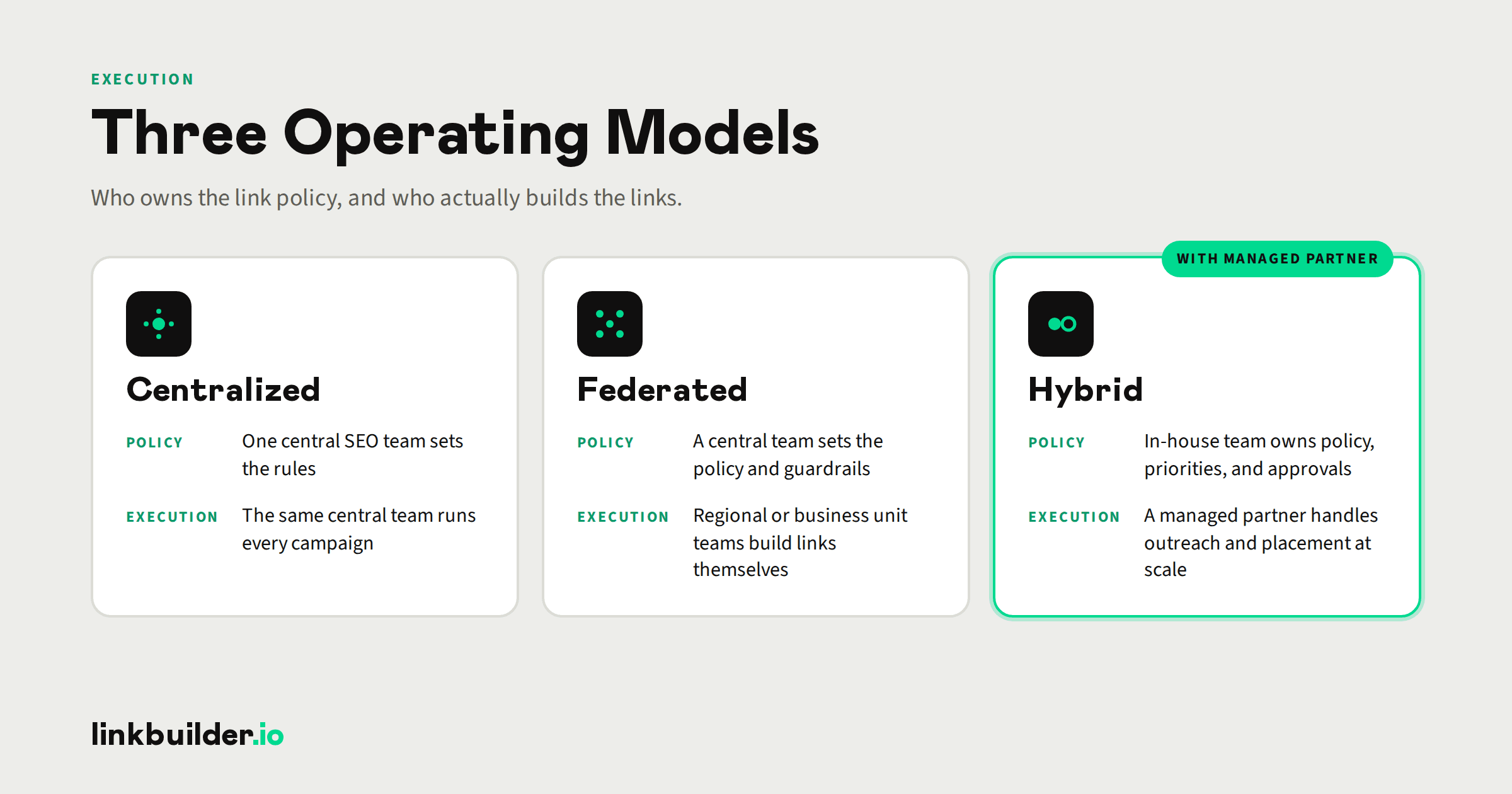
There are three common structures, and the right one depends on how centralized your marketing organization already is.
Centralized: one SEO team owns strategy, policy, vendor management, and reporting for all properties. Business units submit requests and receive links. Clean and consistent, but it bottlenecks when the central team is small relative to the estate.
Federated: central SEO owns the policy and the reporting layer. Business units or regions own execution, either in-house or through their own vendors, within the policy. This is the model most large organizations end up with because it matches how budgets are already allocated.
Hybrid with a managed partner: central SEO owns policy and prioritization, and a single managed link building partner executes across properties, with regional teams feeding briefs and approvals. This works well when the internal team is small but the estate is large, because the partner absorbs the coordination load.
Whichever you pick, someone needs to be the named owner of the link program at the company level. Not “the SEO team.” A person. Enterprise link building fails without a single point of accountability more often than it fails for any tactical reason. If you’re building that function, our post on structuring a link building team covers the roles.
Choose tactics that work at enterprise scale
Not every link building tactic translates. Some get dramatically better with enterprise resources. Others get worse because the brand’s size changes how publishers respond.
Original research and data-led digital PR is where enterprises have a structural advantage. You have proprietary data most companies would pay to see: transaction volumes, customer survey panels, usage patterns, market pricing. Packaging that into a study that journalists want to cite produces links from publications your outreach team could never pitch cold. It also produces the kind of non-commodity content Google’s own guidance on generative AI search says its AI systems favor, which matters for how your brand shows up in AI Overviews and AI Mode, not just blue links. Our Digital PR Plus guide walks through how earned links and brand mentions compound together.
Unlinked mention reclamation scales with brand size. A large brand gets mentioned constantly without a link: trade press, analyst reports, partner announcements, conference recaps. A systematic reclamation process turns those into links at a fraction of the cost of new outreach. We cover the process in our guide to unlinked brand mentions. The enterprise version needs monitoring across every property and brand name variant, and a fast-response outreach template that a junior team member can run weekly.
Guest posting still works, but the standard is different. At enterprise scale, one placement on the wrong site is a brand risk, not just a wasted link. Vetting, disclosure, and placement strategy all need to be tighter than a standard program, which is why we wrote a separate guide to guest posting at the enterprise level.
Partner and ecosystem co-marketing works when it’s editorial. Integration announcements, joint case studies, and co-authored research with technology partners produce legitimate, relevant links. What doesn’t work is the version where the partnership team negotiates link placement as a deliverable. That’s the contract-link problem from the policy section, and it turns a good tactic into a liability.
Regional and local links for multi-market properties. If you operate in eight countries, each country site needs links from publishers in that country, in that language. Centralized outreach teams tend to underinvest here because it’s harder. It’s also where a lot of the geographic targeting signal comes from.
Solve the approval problem before it solves you
The single biggest execution failure in enterprise link building is approval latency. An editor accepts a piece on Monday. Legal reviews it the following Thursday. Brand asks for changes. The editor moved on two weeks ago.
Fix this structurally, not with reminders. Pre-approve content categories and publisher tiers so that placements within an approved category on an approved tier don’t need individual review. Reserve full review for anything outside that box. Agree on a service-level target with legal and brand (48 hours is realistic for most organizations) and report against it. When approval time shows up in the same dashboard as link count, it gets fixed.
Scaling: Add Volume Without Adding Risk
Once the program is running, the pressure shifts to growth. More links, more properties, more markets. Scaling well means growing the output while keeping the profile looking like what it is: a large brand earning coverage.
Set velocity by property, not by company
An enterprise with a strong parent domain and a new acquired brand shouldn’t run the same monthly link target on both. The parent can absorb a high link velocity because it’s already earning links at volume. The acquired brand can’t. Pushing it to the same pace produces a spike that looks exactly like a paid campaign, because it is one.
Set velocity targets per property based on its current referring domain growth, its competitors’ growth, and its tier. Review quarterly. The goal is that each property’s growth curve looks plausible on its own, independent of the parent.
Manage vendors as a portfolio
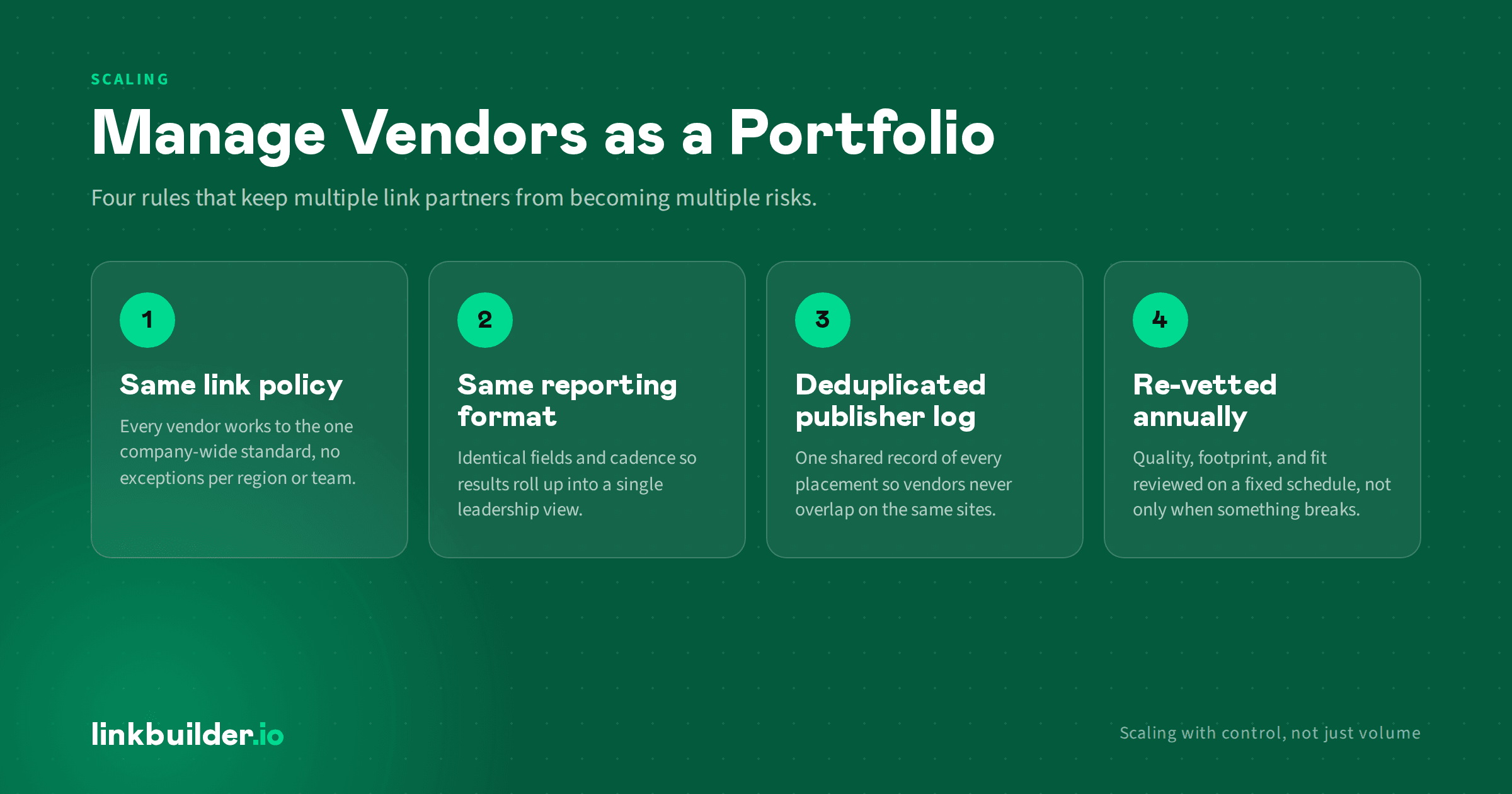
Most enterprises end up with more than one link building partner, either by design (regional specialists, vertical specialists) or by accident (business units hired their own). Either way, you’re managing a vendor portfolio, and it needs the same discipline as any other.
Every vendor works to the same link policy. No exceptions for legacy relationships.
Every vendor reports in the same format, with the same fields: target URL, anchor, publisher, placement date, cost, and the quality metrics your team uses to vet sites. If reporting formats differ, you can’t see duplication or footprint problems across the portfolio.
Every vendor is deduplicated against the others. Two agencies pitching the same 40 publishers for the same brand is wasteful at best and looks coordinated at worst. A shared publisher log, updated weekly, is the minimum.
Every vendor is re-vetted annually. Agencies change ownership, change methods, and change quality. Our guide on how to choose a link building agency covers what to check, and the enterprise addition is simple: ask for a sample of the last 20 placements they built for any client, and vet those sites yourself.
If you’re an agency reading this because you serve enterprise clients, a white label link building arrangement with a single execution partner is often how you meet this standard without building the capacity in-house.
Control the footprint
Scale makes patterns visible. Fifty placements from one agency might share a writing style, a bio format, a link placement position, or a small pool of publishers. Across ten agencies and five years, those patterns compound.
Google’s spam policies specifically call out using subdomains, subdirectories, or new sites to continue a violating pattern as policy circumvention, which means an enterprise can’t isolate risk by pushing aggressive tactics onto a secondary property. The whole estate is evaluated together.
The practical controls: rotate publishers across vendors, vary content formats and author bylines, cap the share of any single publisher in the total profile, and run a quarterly footprint audit that looks at the last 200 placements as a set rather than individually. If a pattern is obvious to your team, assume it’s obvious to a classifier.
Measuring and Reporting to Leadership
Enterprise link programs get funded or cut based on how they’re reported, not just how they perform. Two audiences need two different reports.
The operational report is for the SEO team and vendors. It tracks placements against plan by property and tier, anchor distribution against policy, approval latency, cost per placement, vendor performance, and footprint metrics. Weekly or biweekly.
The leadership report is for the people who approve the budget. It should fit on one page and connect link investment to outcomes they already care about: organic revenue or pipeline by property, ranking movement on Tier 1 keywords, and share of voice against named competitors. If you need help building the attribution model, our guide to link building ROI walks through it.
Add one more line to the leadership report: visibility in AI search. Google’s Search Console now includes a Generative AI performance report showing how your content surfaces in AI features, and Google’s own documentation describes how AI Mode uses query fan-out to pull from multiple sources across a topic. A brand that’s cited consistently across a topic cluster shows up in more of those fan-out queries. Links from authoritative, topically relevant publishers are part of how that citation footprint gets built, which means enterprise link building now has a second measurable outcome beyond rankings. Our post on generative engine optimization covers how to track it.
Set realistic expectations on timing. Enterprise programs typically take longer to show ranking movement than smaller campaigns because the pages are more competitive and the approval cycle is slower. Our guide to link building timelines by vertical gives leadership a benchmark to hold you to that isn’t invented.
How LinkBuilder.io Works With Enterprise Teams
We’ve spent years running link building for large, multi-property brands, and most of what’s in this guide came from watching what broke.
For enterprise clients, we operate as the execution layer in a hybrid model. Your team owns the link policy and prioritization. We build the target page plan across properties, run competitor gap analysis per market, handle outreach and placement under your policy, and report in a single format across everything we build. You get one point of contact, one publisher log, and one set of quality standards regardless of how many properties or regions are in scope.
Our link building services page covers the full range, and our case studies show what the work produces for brands at scale.
Frequently Asked Questions
How is enterprise link building different from regular link building?
The tactics overlap almost entirely. The difference is the management layer: multiple properties competing for investment, multiple stakeholders with approval authority, a link profile large enough that patterns are visible, and vendor procurement that shapes which partners you can use. Enterprise link building is mostly a governance discipline with outreach attached.
Should enterprises build links in-house or use an agency?
Most large organizations end up with a hybrid. A small central team owns policy, prioritization, and reporting. Execution is split between in-house capacity for relationship-heavy work (partner co-marketing, original research) and one or more agencies for outreach volume. Fully in-house works if you can staff a team of four to six and keep them. Fully outsourced works if the central owner is strong enough to hold vendors to a shared standard.
How long does enterprise link building take to show results?
Longer than a single-site campaign. Competitive Tier 1 pages in established categories typically need several months of consistent link acquisition before ranking movement is clear, and approval cycles add time on top of that. Plan for a six to twelve month horizon before the leadership report shows what you want it to show, and set that expectation up front.
Does enterprise link building help with AI search visibility?
Yes, indirectly. Google’s generative AI features draw on its core ranking systems, and links remain part of how those systems evaluate authority. Beyond that, the digital PR and original research tactics that produce enterprise-grade links also produce the brand mentions and citations that AI systems surface. Track it in Search Console’s Generative AI performance report alongside your traditional metrics.
The Short Version
Enterprise link building is a governance problem first. Map the estate, tier it by revenue, write one link policy the whole company works to, name an owner, and manage vendors as a portfolio with shared reporting. Do that, and the outreach mostly takes care of itself.
If you’d rather hand the execution layer to a team that’s done it before, book a call and we’ll walk through your estate together.
Erika
Head of Link Operations